Is biblical chronology important to modern Christians?
The following article is abstracted from The Biblical Chronologist Volume 1, Number 2 and The Biblical Chronologist Volume 1, Number 3. Full details and references can be found there.
Should Christians concern themselves with Biblical chronology? Is it important?
Yes, they should; yes, it is important. It is important because our ability to defend the truth of Christianity hinges upon it.
Biblical Chronology and Apologetics
To see why this is so we need to take a brief look at the relationship between Biblical chronology and Christian apologetics. Since apologetics is not a household word, I have highlighted its definition below.
apologetics: a branch of theology devoted to the defense of the divine origin and authority of Christianity. (Webster's Ninth New Collegiate Dictionary)
Biblical chronology lies very near the foundation of Christian apologetics. This comes about because apologetics is built upon a foundation of Biblical historicity (i.e., historical factuality), and Biblical historicity is, in turn, founded upon Biblical chronology.
The Importance of Historicity
Wheaton's Professor of Bible and Archaeology, Joseph P. Free, in the middle of the twentieth century, on the opening page of his textbook, Archaeology and Bible History, says it this way:
The Bible is a historical book, and the great truths of Christianity are founded upon the historic facts revealed therein. If the fact of the Virgin Birth, the fact of the Crucifixion, and the fact of the Resurrection be set aside, our faith is without foundation. Since the New Testament revelation stands upon the foundation of the Old Testament, the accuracy of the Old Testament is of great importance to us.
In a much more recent video series, theologian R. C. Sproul says it this way:
Now just because a book claims to be the Word of God, doesn't make it the Word of God. Just because a book claims to be the unvarnished truth does not make it the unvarnished truth. Anybody can make a claim like that, and more than one book does make that claim. ... We want to look beyond the simple claim, for evidences; what the scholars call the indicia. Is there any evidential basis for agreeing with the claim that Scripture makes?
Now, obviously, in this short period of time I can't give you a full-fledged apologetic for the integrity of sacred Scripture. But let me just give you a brief outline of how the church has proceeded historically to the conclusion that the Bible is not a myth, that it is not fable, that it is not legend, and that it is truth, and that it is infallible truth.
The starting point in the inquiry is this question: ``Does the Bible communicate basically reliable information?'' Is it a basically reliable historical document? Not, is it inspired; not, is it infallible; not, is it any of that; but just, is it a good historical source?
Now, obviously, if the answer to that question is, ``No, it's not even basically reliable,'' there's no reason under the sun why we should spend five minutes in ``recreation'' attending its message.
Both scholars make the same point: if the Bible can be convicted of any falsehood in regard to history, then there is no basis for the claim that Christianity is true. The defense of the truth of Christianity is entirely dependent upon the truth of Biblical history; Christian apologetics is rooted in Biblical historicity.
Chronology: the Backbone of History
This explains why Biblical historicity is important. But why is Biblical chronology important?
It is evident that there is an intimate connection between history and chronology. As has often been stated: ``chronology is the backbone of history.'' Because of this close relationship, it is, in fact, essentially impossible to defend Biblical historicity apart from a true and accurate Biblical chronology.
The past several centuries of church history seem to me to have clearly demonstrated this fact. It is surely no coincidence that the rise of theological liberalism (which is conceived in a rejection of Biblical historicity) followed on the heels of the attack on the historic Christian doctrine regarding the date of Creation. I suggest that the existence of the phenomenon of liberalism within the church is very largely a result of a failure in Biblical chronology -- a failure to correlate Biblical history, including the Creation and the Flood, with extra-Biblical data in a fashion which was intellectually satisfying and, at the same time, true to both the text of Scripture and the data of science.
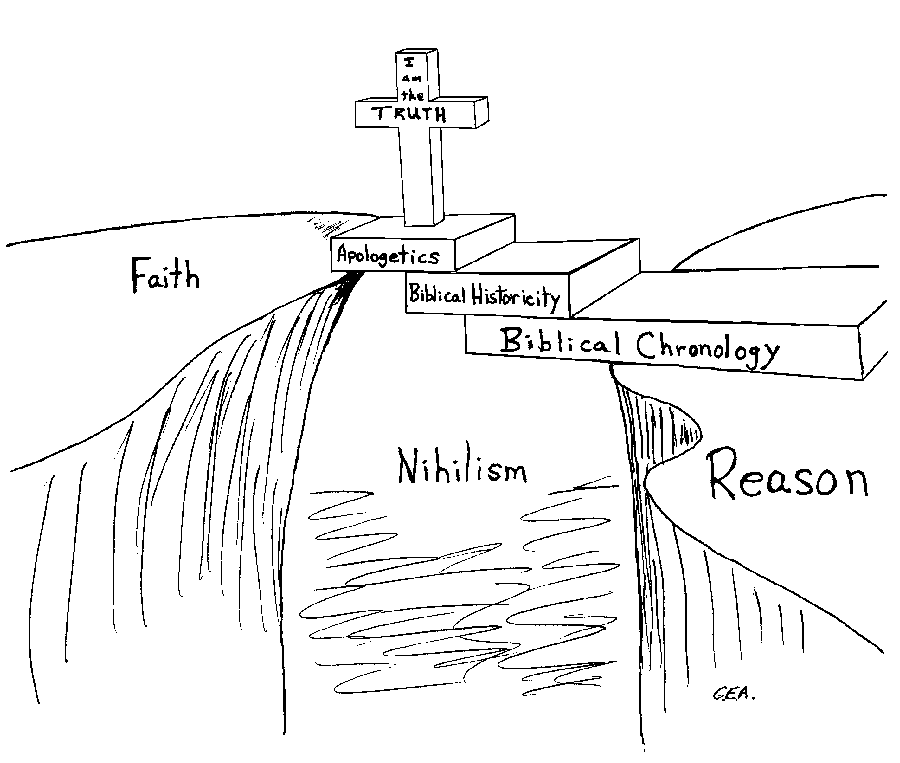
I have tried to summarize and illustrate my thoughts in this regard in the sketch above. I picture Biblical Chronology as a foundation block extending from the heights of Reason toward the heights of Faith. In itself it cannot span the chasm between, but upon it is laid another foundation block called Biblical Historicity. It also is too short to span the remaining gap, but upon it a final block called Apologetics is laid. This final block is able to bridge the remaining distance, thereby linking Faith and Reason and completing the foundation of Truth. If Biblical Chronology is removed or broken, the remainder is lost into the chasm called Nihilism.
The foregoing article was abstracted from The Biblical Chronologist Volume 1, Number 2 and The Biblical Chronologist Volume 1, Number 3. Full details and references can be found there.
|